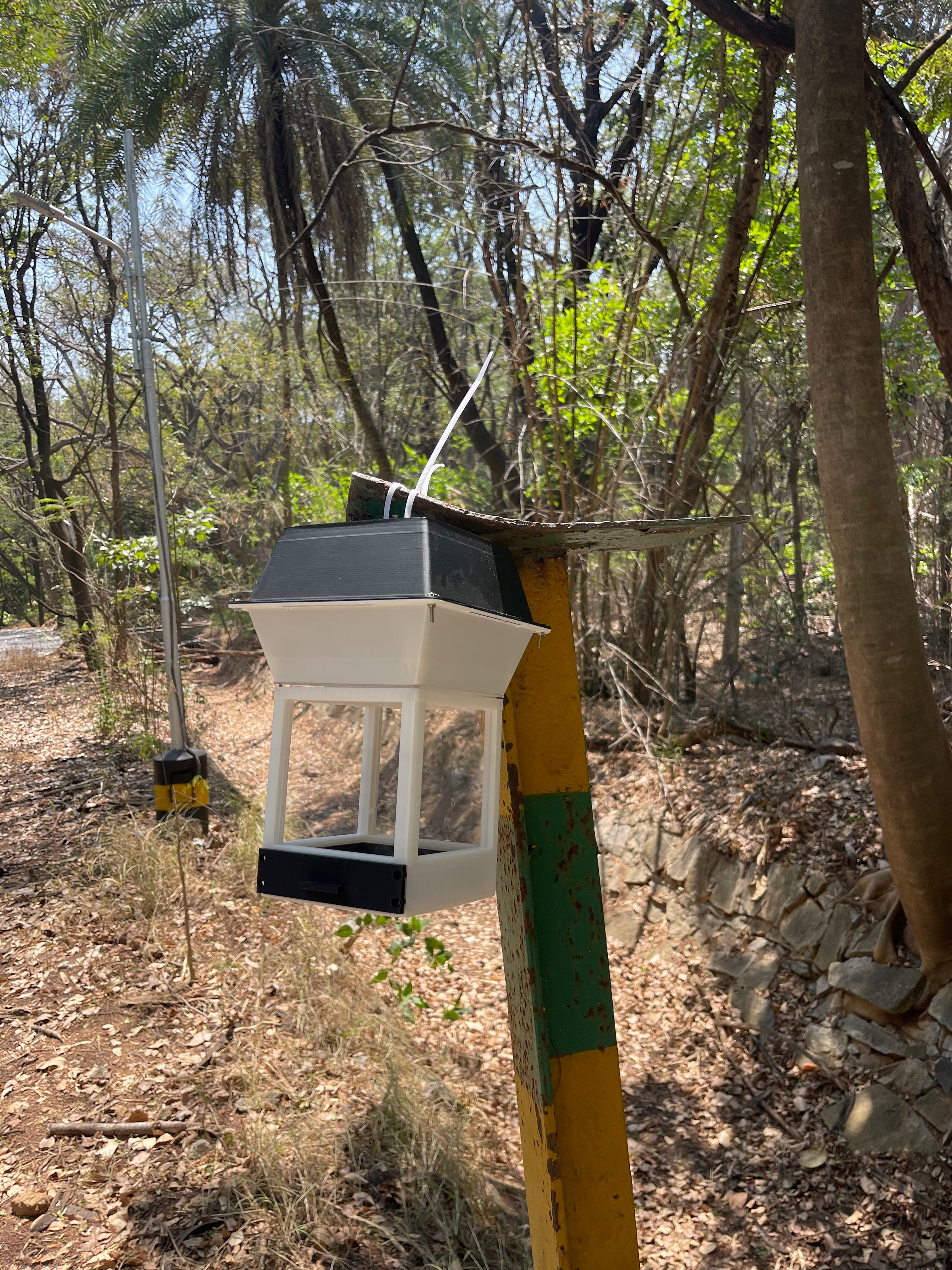
Whether the trap is in a field, a warehouse, or a research plot, EntoVision turns it into a source of structured data. Cameras above, software around them, and a dashboard that surfaces what you couldn't see before.
EntoVision puts a small, battery-powered camera unit above any trap or collection surface. That could be a sticky trap in a field, a pheromone trap in a warehouse, or a light trap at a research site. The camera takes a picture on schedule, sends it over the cellular network, and writes the result into a dashboard you can actually use.
Over a season, one trap produces a few thousand timestamped images. Across a hundred traps and a year, you have a dataset large enough to see patterns that nobody has been able to measure at this resolution before.
The unit runs on a lithium battery, transmits over the cellular network, and needs no power infrastructure at the site. Mounted in a few minutes on standard trap supports, posts, or existing structures, whether that's an orchard row, a warehouse wall, or a transect in the forest.
Trap inspection has always been a manual job. Someone walks to the trap, counts what's on it, writes it down, and walks to the next one. Frequency is low because labour is expensive. Records are sparse because counting takes time. Two people looking at the same trap can disagree on what they see.
That gap costs different people in different ways. Growers miss the rising edge of an outbreak. Warehouse managers find the infestation only after the stock is damaged. Scientists work from sample sizes too small to answer the questions they actually want to ask. Advisory bodies issue warnings late, or not at all.
EntoVision changes what's measurable. The hardware captures the same view of the same trap, on the same schedule, every day. You end up with thousands of entries per site, all in the same format, and that's what makes everything else possible.
We didn't build a branded trap. The camera works above whatever collection surface you already trust, and produces the same kind of measurement regardless of what's underneath.
The same capture protocol applies everywhere. The same dashboard surfaces the data. The same comparisons become possible across sites, seasons, and crop or storage contexts.
Insect populations matter to many kinds of work, and the same underlying data serves all of them. EntoVision is shaped for four audiences in particular.
The same data is useful in different shapes to different people. Someone on the ground wants to see individual frames and current counts. Someone managing many sites wants the aggregate view. Someone writing a report wants a clean summary they can share. EntoVision shows each of these from the same underlying data.
Individual traps, image by image. Current counts, recent captures, and the time-series for every site you're responsible for. Annotate or reclassify when you need to, export when you're done.
All the deployments across your organisation. Add devices, control who sees what, and produce the aggregate reports that go to your stakeholders.
Read-only views of the data your organisation is generating. Clean visualisations, current status, exportable summaries. For people who need to see the picture without changing it.
Each role sees what's useful to them, and nothing more.
EntoVision is in early deployment with a small group of partners across horticulture, storage, and research. If your work involves insect populations and you'd like to evaluate the platform, get in touch and we'll talk.